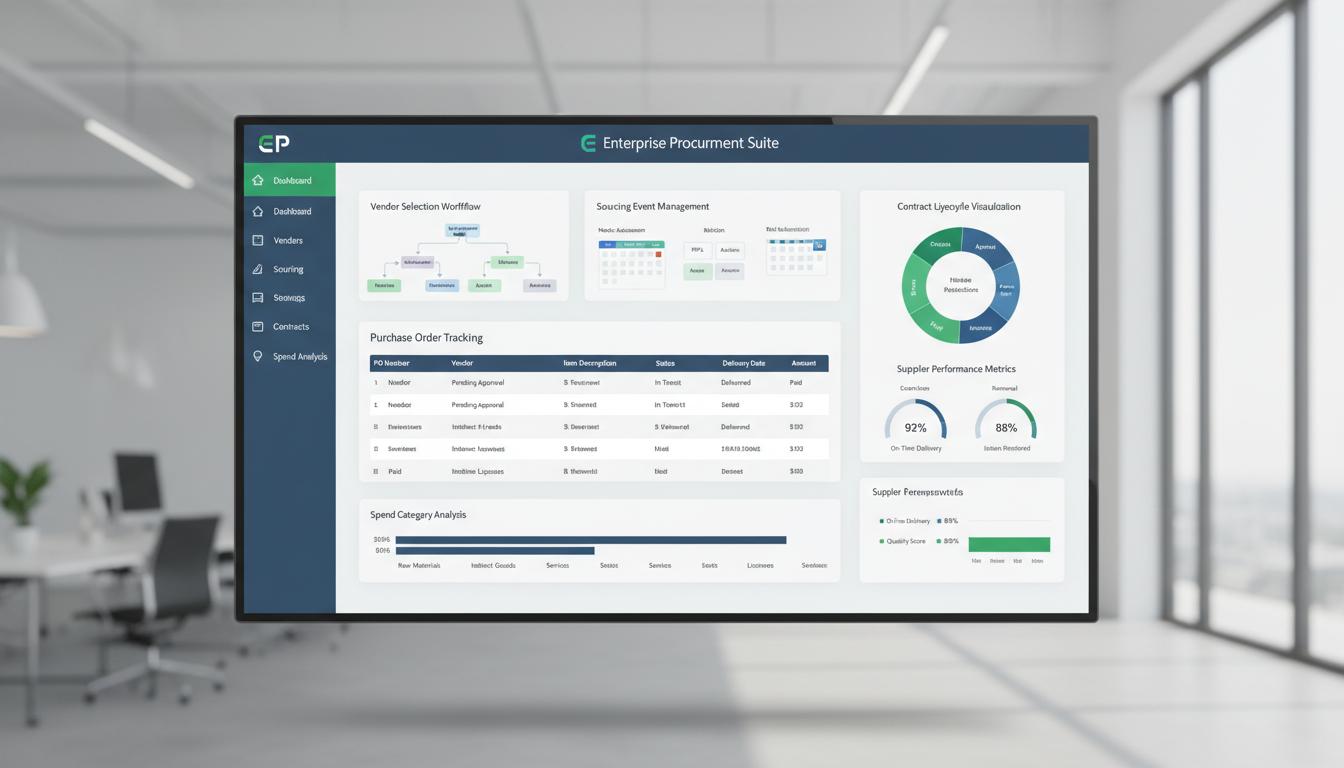
Procurement Management
Transform your procurement process from requisition to purchase order. Streamline sourcing, manage vendor relationships, control spend, and ensure compliance with intelligent procurement automation.
Enforce budgets and preferred vendors to reduce maverick spending by up to 30%.
Reduce purchase order cycle time from days to hours with automation.
Ensure all purchases follow approved processes and contracted terms.
Leverage negotiated contracts and competitive sourcing to save 10-15% on spend.
Provide self-service purchasing with guardrails that ensure compliance.
Manage vendor performance and collaborate on continuous improvement.
Our SOPs are built on years of industry experience and best practices from leading finance teams.
Require requisitions for all non-inventory purchases above defined thresholds. Include business justification, budget account, and vendor information. Route for approval based on amount, category, and department. Convert approved requisitions to purchase orders automatically. Track requisition status and communicate delays to requesters.
Generate POs from approved requisitions with standard terms and conditions. Transmit POs to vendors via preferred method: EDI, email, portal. Confirm vendor acknowledgment within 24 hours. Track PO acknowledgment and delivery status. Manage PO changes through formal amendment process. Close POs upon complete receipt and invoice matching.
Identify sourcing opportunities based on spend analysis and contract expiration. Define sourcing strategy: RFP, RFQ, auction, or direct negotiation. Evaluate vendor responses using standardized scorecards. Conduct due diligence on selected vendors. Negotiate terms and document in formal contracts. Communicate decisions to all participating vendors.
Maintain repository of all active contracts with key terms and expiration dates. Track contract compliance: volume commitments, pricing tiers, rebates. Set alerts for contract expiration (90, 60, 30 days). Route renewal decisions through appropriate approval process. Document contract amendments and change orders. Analyze contract performance against benchmarks.
Deep domain expertise built into every feature, based on years of industry experience.
Need Identification triggers the procurement process. Requisition captures requirements and business justification. Approval ensures budget availability and policy compliance. Sourcing selects vendors and negotiates terms. Purchase Order formalizes the purchase commitment. Receipt confirms goods/services delivery. Invoice Processing validates and pays for received items.
Strategic items (high value, high risk) require detailed sourcing and relationship management. Leverage items (high value, low risk) focus on competitive pricing and efficiency. Bottleneck items (low value, high risk) ensure supply continuity through inventory or alternatives. Non-critical items (low value, low risk) automate and simplify purchasing.
Segment vendors by spend, criticality, and performance. Develop strategic partnerships with key vendors. Conduct quarterly business reviews with top vendors. Track KPIs: quality, delivery, cost, service, innovation. Implement vendor scorecards for objective evaluation. Maintain vendor risk assessments and contingency plans.
Cost savings: negotiated vs. baseline pricing. Purchase order cycle time: requisition to PO issuance. Contract compliance: spend under contract vs. total spend. Vendor consolidation: number of vendors per category. Maverick spend: purchases outside approved channels. Early payment discount capture: discounts taken vs. offered.