← Back to Home

Vendor & Customer Master Data

Finortal Master Data Management

Maintain clean, accurate, and consistent master data across your entire organization. Our MDM solution ensures data integrity for vendors, customers, and financial dimensions, enabling better decisions and smoother operations.

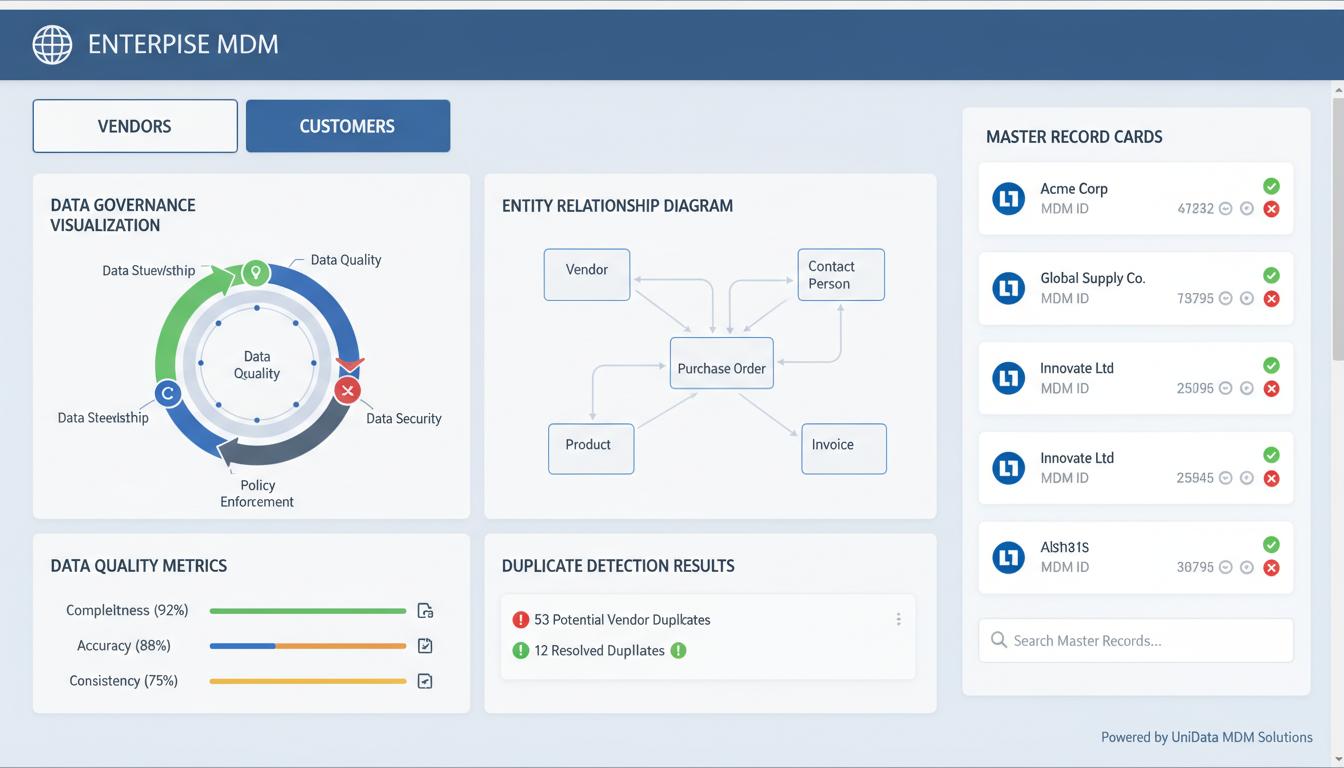
Finortal Master Data Dashboard
95%
Data Accuracy
80%
Duplicate Reduction
99%
Audit Compliance
50%
Onboarding Time Reduction

Everything You Need

Centralized vendor and customer repository
Automated duplicate detection and merging
Data validation and enrichment
Approval workflows for master data changes
Integration with multiple ERP systems
Data quality scoring and monitoring
Change history and audit trails
Self-service vendor onboarding portal

Why Choose Finortal Master Data?

1

Eliminate Duplicates

Detect and merge duplicate records automatically, reducing confusion and errors.

2

Improve Data Quality

Validate data at entry and maintain quality standards across all systems.

3

Ensure Compliance

Maintain complete audit trails and enforce data governance policies.

4

Reduce Risk

Identify fraudulent vendors and prevent payments to unauthorized entities.

5

Streamline Operations

Provide consistent data across all systems and business processes.

6

Enable Self-Service

Allow vendors to maintain their own information through secure portals.

Industry Best Practices

Our SOPs are built on years of industry experience and best practices from leading finance teams.

Vendor Onboarding SOP

Collect required information: legal name, tax ID, address, banking details, contacts. Validate tax ID with IRS or equivalent authority. Verify bank account ownership through micro-deposits or bank confirmation. Screen against sanctions lists and watchlists. Assign vendor category and default payment terms. Obtain required compliance documentation: W-9, insurance certificates, contracts.

Data Quality Management SOP

Define data quality rules for each master data field. Implement validation at point of entry: format checks, required fields, reference data. Run periodic data quality reports identifying exceptions. Establish data stewardship roles and responsibilities. Cleanse data through standardization, validation, and enrichment. Monitor data quality scores and trends over time.

Duplicate Management SOP

Configure matching rules: exact match, fuzzy match, phonetic match. Set match confidence thresholds for automatic vs. manual review. Review potential duplicates weekly and determine merge or separate actions. Preserve historical transaction references during merges. Communicate duplicate resolutions to affected departments. Track duplicate creation rate to identify process improvements.

Change Management SOP

Route master data changes through approval workflows based on field sensitivity. Critical changes (bank account, tax ID) require additional verification. Document change requests with business justification. Notify stakeholders of approved changes. Update all integrated systems simultaneously. Maintain change history with before/after values and approver information.

Expert Insights

Deep domain expertise built into every feature, based on years of industry experience.

Master Data Domains

Vendor Master includes suppliers, service providers, and payees. Customer Master includes all billing and shipping entities. Chart of Accounts defines financial reporting structure. Cost Centers and Profit Centers enable managerial accounting. Product Master contains item details, pricing, and categorization. Location Master tracks physical sites and addresses.

Data Governance Framework

Data Ownership assigns accountability for data quality to business units. Data Stewardship defines operational responsibilities for maintaining data. Data Policies establish rules for creation, modification, and deletion. Data Standards ensure consistency in formats, codes, and naming conventions. Data Quality Metrics measure accuracy, completeness, timeliness, and consistency.

Duplicate Detection Methods

Exact matching identifies records with identical key fields. Fuzzy matching finds similar records using algorithms like Levenshtein distance. Phonetic matching (Soundex) catches name variations. Address standardization normalizes formats before matching. Statistical matching uses probability models based on multiple fields. Machine learning models improve matching accuracy over time.

Integration Patterns

Hub architecture centralizes master data in a single repository. Federated approach maintains data in source systems with virtual integration. Synchronization keeps multiple systems updated through real-time or batch interfaces. Golden record concept creates single version of truth from multiple sources. API-first design enables modern integration approaches.